Liwal
XPS foam board is becoming increasingly popular for sculpting, carving, model making, architectural models, dioramas, terrain building, prop making, signage, prototyping, arts and crafts, and many other creative applications.
Also known as
extruded polystyrene foam, Liwal XPS foam is lightweight, rigid, easy to shape, and available in different thicknesses. While Liwal
XPS foam board is commonly used as a thermal insulation material in construction, artists, sculptors, architects, students, model makers, designers, prop makers, and hobbyists also use it as a versatile material for creative projects.
If you are searching for XPS foam board for sculpting, XPS foam for carving, sculpting foam, high-density foam board, model making foam, or foam sheets for crafts, XPS foam is a material worth considering.
What Is Liwal XPS Foam Board?
XPS stands for Extruded Polystyrene. It is a rigid, closed-cell foam material manufactured through an extrusion process. The result is a lightweight foam board with a relatively smooth and consistent internal structure.
Unlike some packaging foams, XPS foam can be cut, carved, shaped, sanded, engraved, layered, textured, glued, and finished. These characteristics make XPS foam board useful for both small detailed models and large lightweight sculptures.
Why Use Liwal XPS Foam Board for Sculpting?
One of the biggest advantages of XPS foam for sculpting is that it is easy to shape while remaining lightweight.
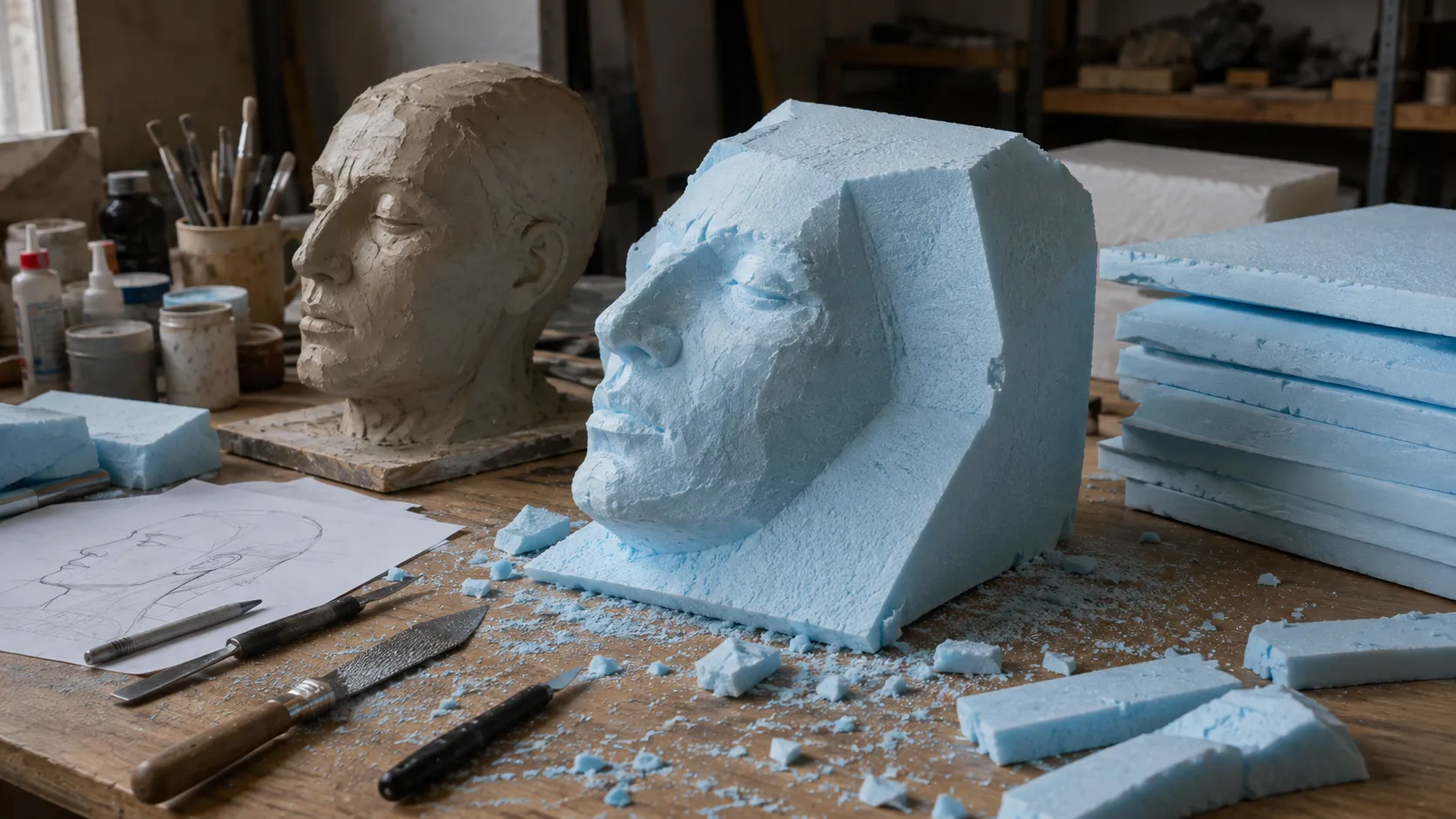
Artists can start with a thick XPS foam board or glue several XPS sheets together to create a larger foam block. The block can then be cut and gradually carved into the required shape.
XPS foam for sculpting offers several advantages, including lightweight construction, easy cutting, easy carving, smooth shaping, sanding capability, simple layering, and the ability to create both small and large three-dimensional forms.
This makes XPS foam particularly useful when creating large sculptures, props, exhibition displays, decorative pieces, and installations where using wood, plaster, concrete, or other solid materials would result in excessive weight.
Liwal XPS Foam Board for Sculpture and Art
Artists can use XPS foam board to create many different types of sculptures and artistic forms.
XPS foam can be used for abstract sculptures, decorative statues, geometric artwork, wall sculptures, relief artwork, oversized objects, artificial rocks, decorative architectural forms, exhibition installations, prototype sculptures, and artistic displays.
Multiple XPS foam sheets can be bonded together to create thicker blocks before carving. Once the basic shape has been produced, the surface can be refined, textured, coated, and painted using suitable foam-compatible products.
Liwal XPS Foam for Carving
XPS carving foam is popular because of its relatively consistent structure. It can be shaped gradually to create curves, angles, recesses, textures, and other details.
People searching online for carving foam for artists, foam for sculpture, foam blocks for carving, high-density carving foam, or XPS foam for carving may find XPS suitable for many creative applications.
The appropriate cutting and carving method will depend on the thickness and density of the XPS foam as well as the level of detail required.
Liwal XPS Foam for Model Making
XPS foam board is also widely used for model making.
Architects, designers, engineering students, architecture students, hobbyists, and professional model makers can use XPS foam to quickly transform an idea or digital design into a physical model.
XPS model making applications can include architectural models, landscape models, topographic models, building models, product prototypes, conceptual models, miniature structures, presentation models, and design-development models.
Because XPS foam is lightweight and relatively easy to shape, designers can experiment with different forms without immediately moving to heavier or more expensive materials.
Liwal XPS Foam for Architectural Models
XPS foam for architectural model making can be particularly useful for creating building masses, landscape contours, terrain, and conceptual forms.
Architectural students and professional model makers can use XPS foam for site models, building massing models, contour models, landscape models, urban planning models, conceptual architecture models, interior design mockups, and exhibition models.
Large architectural models made from XPS foam can also remain relatively lightweight, making them easier to transport between studios, universities, offices, exhibitions, and presentations.
Liwal XPS Foam for Dioramas and Miniatures
XPS foam for dioramas is another popular application.
Miniature builders can carve XPS foam into mountains, cliffs, rocks, caves, roads, hills, riverbanks, ruins, brick walls, stone walls, concrete surfaces, dungeon floors, building foundations, and other miniature scenery.
The material can therefore be useful for railway layouts, miniature landscapes, scale models, tabletop gaming terrain, fantasy scenery, and realistic dioramas.
Liwal XPS Foam for Tabletop Gaming Terrain
XPS foam terrain is popular among tabletop gaming and miniature enthusiasts.
XPS sheets can be transformed into miniature castles, dungeon tiles, ruined buildings, rocky landscapes, science-fiction structures, roads, bridges, hills, mountains, walls, and modular gaming boards.
Because XPS foam is lightweight, relatively large terrain pieces can remain easy to move, store, and transport.
Liwal XPS Foam for Cosplay Props
XPS foam can also be used for certain cosplay props and costume-related projects, particularly where thick, lightweight, rigid shapes are required.
Possible applications include helmets, fantasy objects, oversized costume props, decorative accessories, mechanical forms, armor prototypes, character props, and other three-dimensional shapes.
For wearable projects, creators should consider durability, surface protection, weight distribution, and whether XPS is appropriate for the intended application.
Liwal XPS Foam for Prop Making
XPS foam for prop making is useful when an object needs to look large and substantial without becoming extremely heavy.
Theatre productions, film sets, exhibitions, events, retail displays, and themed environments may require oversized objects that would be difficult or expensive to produce from traditional solid materials.
XPS foam can be used to create decorative columns, artificial rocks, statues, architectural details, oversized product replicas, stage scenery, themed objects, exhibition props, and temporary display structures.
Liwal XPS Foam for Faux Rocks and Artificial Stone
XPS foam is frequently used to create fake rocks and artificial stone effects.
By layering, carving, cutting, and texturing the foam, creators can imitate natural stone without using heavy rocks or masonry.
XPS foam can be used to create artificial boulders, decorative rock walls, cave scenery, themed displays, miniature landscapes, stage scenery, and exhibition installations.
The appropriate coating and finishing system should always be selected according to the environment in which the finished project will be used.
Liwal XPS Foam for 3D Letters and Sign Making
XPS foam can also be used for large 3D letters, logos, signs, and branding displays.
Large dimensional lettering made from traditional materials can become heavy and difficult to install. XPS foam allows creators to produce large shapes while keeping the overall structure lightweight.
XPS foam for signage can be used for 3D logos, shop displays, event lettering, wedding decorations, exhibition signs, photo backdrops, stage names, brand installations, promotional displays, product launches, and decorative wall lettering.
Liwal XPS Foam for Events and Exhibitions
Event companies and exhibition contractors often require large decorative objects for temporary installations.
XPS foam can be useful for exhibition stands, event props, product replicas, stage decorations, photo zones, promotional displays, large logos, branded sculptures, themed environments, and temporary architectural features.
Its lightweight nature can help make large decorative pieces easier to transport and install.
Liwal XPS Foam for Prototyping and Product Design
XPS foam can be used for rapid physical prototyping.
Industrial designers and product designers often need to evaluate the size, proportions, ergonomics, and overall appearance of a product before manufacturing a final version.
XPS foam prototypes can be useful for product design models, industrial design concepts, furniture concepts, packaging designs, automotive styling studies, ergonomic models, and large form-development projects.
A foam prototype does not necessarily need to function. In many cases, its purpose is simply to help designers understand the physical dimensions and appearance of an idea.
Liwal XPS Foam for CNC Cutting
Depending on the foam specification, equipment, tooling, and machine setup, XPS foam may be suitable for certain CNC foam cutting and machining applications.
CNC fabrication can help produce repeatable shapes for sculptures, prototypes, signs, logos, displays, architectural forms, molds, patterns, and decorative elements.
Machine settings should always be selected according to the particular XPS foam and equipment being used.
Liwal XPS Foam for Hot Wire Cutting
Hot wire cutting is another method associated with polystyrene foam because it can create smooth curves and large shapes.
However, heating polystyrene can release harmful fumes. Hot-wire cutting should only be performed with appropriate equipment, ventilation or extraction, fire precautions, and in accordance with manufacturer safety instructions.
How to Cut Liwal XPS Foam Board
There are several ways to cut XPS foam board depending on its thickness and the required shape.
Appropriate knives and foam cutting tools can be used for many straight cuts and basic shapes. Thicker boards and complex designs may require specialized tools or professional foam fabrication equipment.
After the basic form has been cut, sanding and other shaping techniques can be used to refine the surface.
How to Glue Liwal XPS Foam Together
For large sculptures and models, multiple XPS foam sheets can be glued together to create a thicker block.
It is important to use an adhesive that is compatible with XPS and polystyrene foam.
Some solvent-based adhesives can attack or dissolve polystyrene. Always check the adhesive manufacturer's specifications and test the product on a small piece of foam before using it on the main project.
Can You Sand Liwal XPS Foam?
Yes. XPS foam can be sanded, which makes it useful for creating smooth curves and refined shapes.
After removing larger sections through cutting and carving, sanding can help refine the final form.
Suitable respiratory protection and dust control should be used when sanding foam, particularly when producing significant quantities of fine particles.
Can You Paint Liwal XPS Foam Board?
XPS foam can be painted, but it is important to use paint and coatings that are compatible with polystyrene.
Some solvent-containing paints, primers, adhesives, and coatings can damage exposed XPS foam.
Always check product compatibility and test the paint or coating on a small offcut before applying it to the entire sculpture or model.
How to Make Liwal XPS Foam Stronger
Raw XPS foam is lightweight and easy to shape, but its surface can be damaged by impact.
For projects requiring additional durability, an appropriate protective coating or hard-coat system may be applied after sculpting.
The correct finishing system depends on whether the finished piece will be indoors or outdoors, temporary or permanent, decorative or functional, and whether it will be exposed to weather, sunlight, moisture, or frequent handling.
An alternative stronger XPS is Liwal Extruded Polystyrene XPS Foam Tile Backer Board
Liwal XPS Foam for Outdoor Sculptures
XPS foam can potentially be incorporated into outdoor creative projects, but outdoor applications require additional planning and suitable protection.
Outdoor XPS foam projects may require weather-resistant coatings, UV protection, reinforced surfaces, suitable adhesives, water-resistant finishing systems, and secure mounting.
Permanent installations, public spaces, construction projects, and safety-critical applications should always comply with relevant regulations and manufacturer requirements.
Liwal XPS Foam vs EPS Foam for Sculpting
A common question is whether XPS or EPS foam is better for sculpting.
EPS stands for expanded polystyrene and typically has a visible bead structure. XPS generally has a more uniform structure, which can make it attractive for projects requiring smoother carving and finer detailing.
EPS may be useful for very large-volume shapes and other applications, while XPS is often selected when cleaner carving and smoother surface finishing are priorities.
The best option depends on the project's size, required detail, budget, finishing method, and intended use.
Who Uses Liwal XPS Foam Board?
XPS foam board has applications across many creative industries and hobbies.
Typical users include sculptors, artists, architects, interior designers, model makers, architecture students, engineering students, product designers, industrial designers, prop makers, cosplay creators, theatre companies, film production teams, exhibition contractors, event decorators, sign makers, visual merchandisers, miniature builders, tabletop gamers, prototyping studios, and fabrication workshops.
Where to Buy Liwal XPS Foam Board for Sculpting: Can buy from Liwal showroom
When choosing XPS foam, consider the board thickness, sheet dimensions, density, surface condition, consistency, intended application, availability, and manufacturer specifications rather than looking only at price.
XPS foam board for sculpting, XPS foam board for carving, XPS sculpting foam, sculpting foam board, foam board for sculpture, carving foam for artists, high density XPS foam, XPS foam sheets, thick XPS foam board, XPS foam blocks, foam blocks for carving, XPS foam for model making, XPS foam for architectural models, architecture model foam, XPS foam for dioramas, diorama foam board, XPS foam for terrain building, tabletop terrain foam, XPS foam for props, prop making foam, XPS foam for cosplay, XPS foam for 3D letters, XPS foam for signage, XPS foam for prototyping, XPS foam for CNC cutting, XPS insulation foam for crafts, extruded polystyrene foam board, XPS foam supplier, XPS foam board near me, and where to buy XPS foam board.
Frequently Asked Questions About XPS Foam
Is Liwal XPS foam good for sculpting?
Yes. XPS foam is popular for sculpting because it is lightweight and can be cut, carved, shaped, textured, and sanded.
Can Liwal XPS foam be carved?
Yes. XPS foam can be carved into both simple and detailed three-dimensional forms using suitable tools and techniques.
What foam is best for carving?
The best foam depends on the project. XPS is a popular option when a relatively uniform structure and smooth carving characteristics are required.
Can Liwal XPS foam be painted?
Yes, but foam-compatible paints and coatings should be used. Some solvents can attack polystyrene foam.
Can Liwal XPS foam be glued together?
Yes. Multiple XPS sheets can be laminated to create thicker blocks using a compatible adhesive.
Is Liwal XPS foam good for architectural models?
Yes. XPS foam can be used for building massing, landscapes, terrain, conceptual structures, site models, and other architectural model-making applications.
Is Liwal XPS foam good for dioramas?
Yes. XPS foam is useful for creating rocks, cliffs, mountains, walls, ruins, roads, terrain, buildings, and other miniature scenery.
Is Liwal XPS foam suitable for 3D letters?
Yes. Its low weight makes XPS useful for large 3D letters, logos, exhibition displays, event decorations, and dimensional signage.
Why Choose Liwal XPS Foam for Creative Projects?
XPS foam board combines low weight, rigidity, easy shaping, and versatility in one material. Although widely known as an insulation product, XPS foam can also be a practical material for artists, model makers, designers, architects, hobbyists, and professional fabricators.
From miniature gaming terrain and architectural models to large sculptures, exhibition displays, theatre props, 3D logos, prototypes, and decorative installations, XPS foam can be transformed into an enormous variety of shapes.
For anyone searching for XPS foam board for sculpting, carving foam, model making foam, architectural model foam, diorama foam, terrain building foam, prop making foam, high-density sculpting foam, or XPS foam sheets, XPS offers a versatile starting point for bringing creative ideas into three-dimensional form.